
Qualcomm originally planned to launch a new chipset codenamed Snapdragon 875G, but the outcome was unexpected. The new chipset ultimately debuted under the name Snapdragon 888.
This new chipset offers a significant upgrade over its predecessor. Its key highlights include the Cortex-X1 core, X60 5G modem, and Adreno 660 GPU, making it Qualcomm’s most powerful chipset to date.
Currently, only the specifications are revealed. What will be the specific performance? We need to wait until we can test the mass-produced device.
Before that, let’s take a look at the November rankings. AnTuTu has released the list of Android devices with the best performance and benchmark scores. The statistics cover the period from November 1 to November 30, 2020.
The list results show average scores rather than the highest, and the statistics for a single model exceed 1,000. In addition, the data is based on AnTuTu V8 test results. If a single model has multiple storage capacity versions on the list, the version with the highest score is considered the main version.
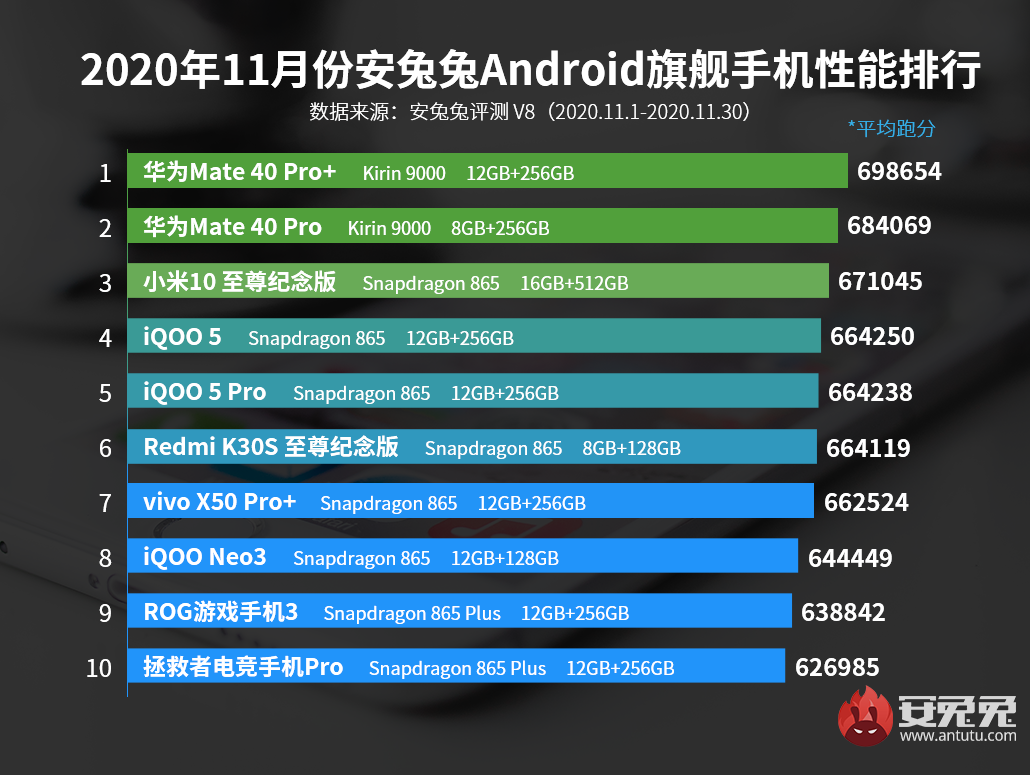
As shown in the list, the top two Android performance rankings are Huawei Mate 40 Pro and Huawei Mate 40 Pro, with average scores of 698,654 and 684,069, respectively. This value represents the average score of all running items. The data shows that some Mate 40 Pro series devices did not enable the system performance mode, so they were unable to utilize the phone’s performance fully.
To fully utilize the Kirin 9000’s performance, Mate 40 series users need to enable Performance Mode in the system settings.
Ranking third is the Xiaomi Mi 10 Extreme Edition (also known as the Xiaomi Mi 10 Ultra), which ranks higher than the previous list. The comparison shows that the device’s GPU score has increased, breaking into the 270,000-280,000 range.
The iQOO 5 series ranks fourth and fifth because the Xiaomi Mi 10 Extreme Edition has been consistently updating its GPU drivers. Although iQOO also has this feature, it doesn’t seem to update as frequently as Xiaomi.
Finally, the phones ranked 6th to 10th are iQOO 5, iQOO 5 Pro, Redmi K30S Extreme Commemorative Edition, Vivo X50 Pro+, iQOO Neo3, ROG Gaming Phone 3, and Legion Gaming Phone Pro. These phones have all been on the market for a while, and the test results meet the expected standards, so the specifications will not be mentioned here.
Next is the performance ranking of mid-range Android devices. All the models on the list support 5G network connectivity.
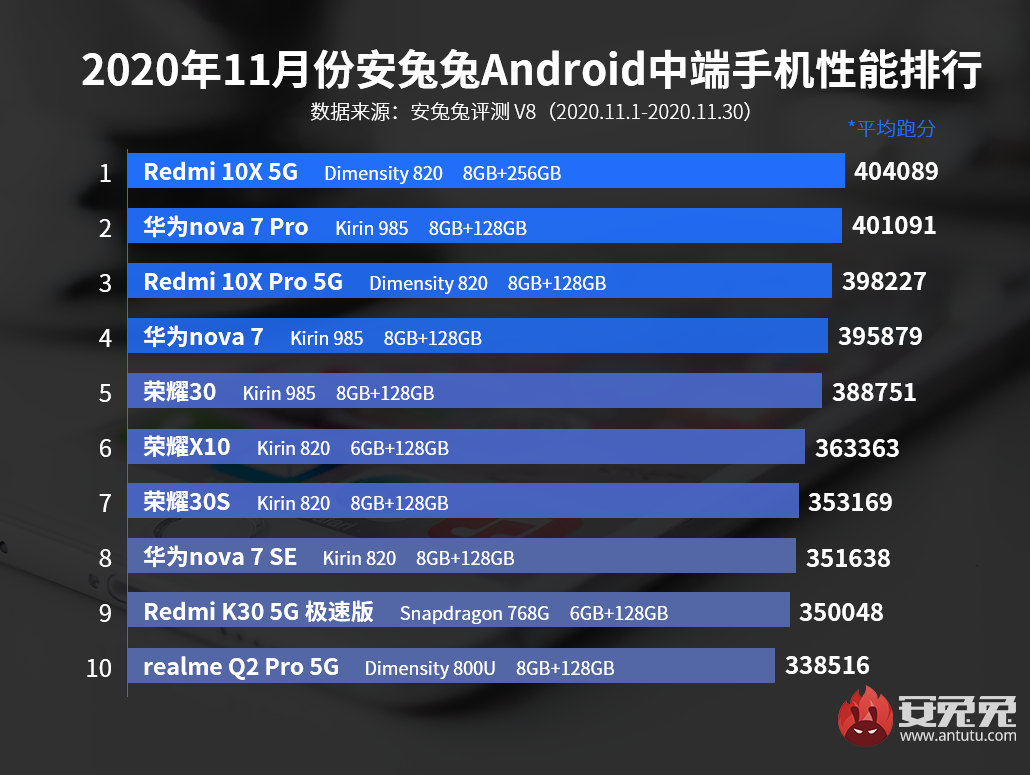
The Redmi 10X 5G is the only phone on the list equipped with the Dimensity 820 5G chipset. Surprisingly, the Redmi 10X Pro scored lower than the Redmi 10X (ranking third). This may be due to the use of different storage variants.
Huawei Nova 7 series devices rank second and fourth. The Nova 7 Pro is in second place, while the Nova 7 is in fourth. These models feature the Kirin 985 chipset. The fifth place goes to the Honor 30, which uses the same chipset and storage configuration.
In positions 6 to 8, we see the Honor X10, Honor 30S, and Nova 7 SE, all with the same Kirin 820 chipset. The 9th spot goes to the Redmi K30 5G with the Snapdragon 768G chipset, while the Realme Q2 Pro 5G takes the 10th spot with the Dimensity 800U chipset.